

I Don’t Say A Word (Instrumental) - Single, from Curse the Evil of the Luck Lord and this version from Song 1 of 20 - from the Geologist album: Leap.....Year 29 February, 2028
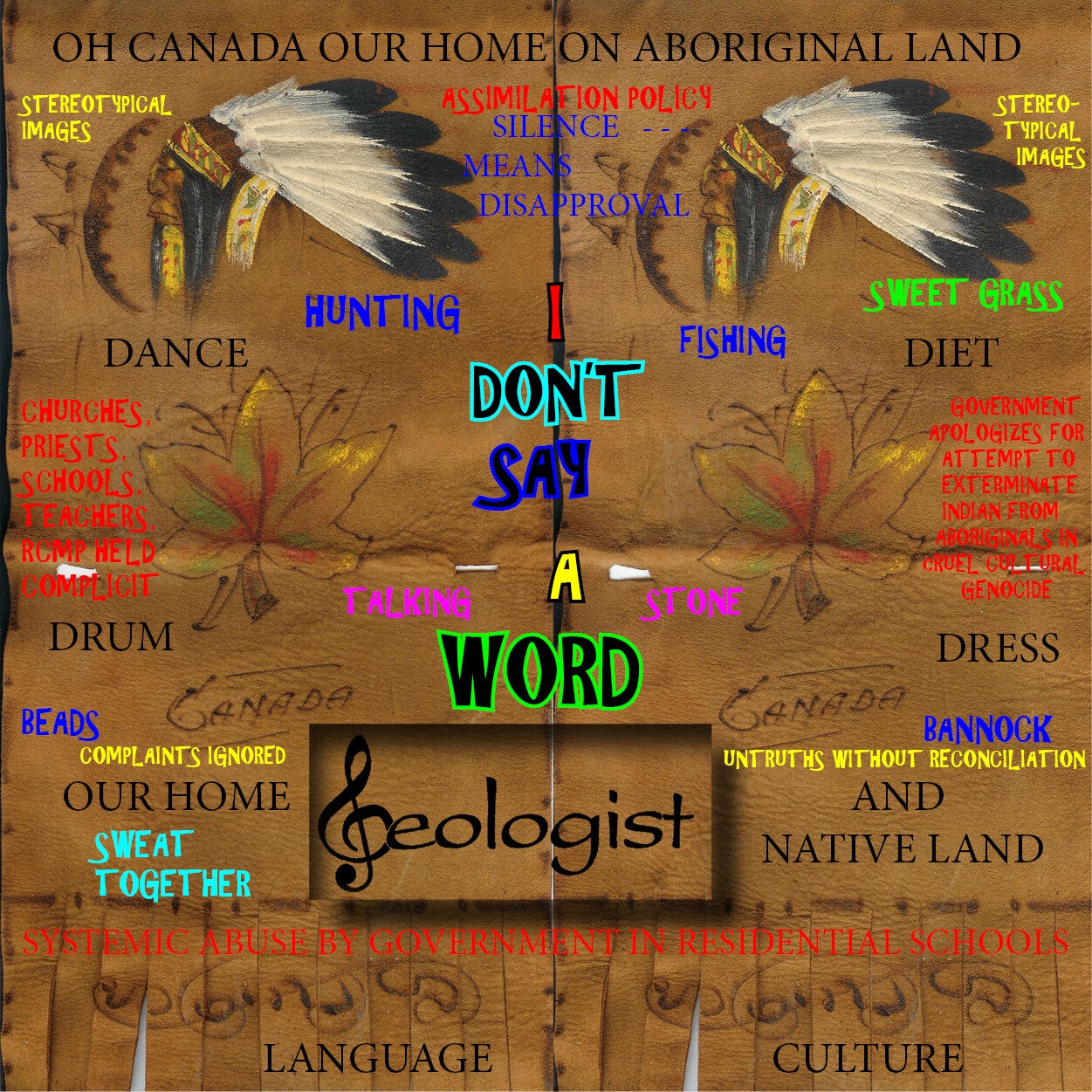


I Don’t Say A Word (Instrumental): 1st version was a Single, 2nd version was from Curse the Evil of the Luck Lord and this version is from Song 1 of 20 - from the Geologist album: Leap.....Year 29 February, 2028-
The first version of this song was released as a Single on November 15, 2011. The second version was released on December 19, 2011 as part of my Curse the Evil of the Luck Lord album. This third version was released March 26-27, 2026 as Song 1 of 20 - from the Geologist album: “Leap.....Year 29 February, 2028.”
The reason it is an instrumental relates to the Department of Northern and Indian Affairs historical "consultations" with Canada's aboriginal communities or with aboriginal communities currently referred to as Canada's First Nations.
The Department of Northern and Indian Affairs often thought their "consultations" were met with approval because First Nations communities sat in dead silence without saying a single word in the auditoriums or meeting places.
But aboriginal culture is an active one where they sit in a circle and pass a talking stone so that everyone has a say. Genuine consultations must meet a rigorous test of unanimous approval. That requires noisy talking until all issues are settled.
In fact, aboriginal communities who remained dead silent without saying a word were disapproving of everything Northern and Indian Affairs imposed upon them.
This album cover was originally designed to be a child's game of spotting the error on the cover.
It was my reference to residential schools, where Canada sent the RCMP and Social workers to scoop aboriginal children from their parents for transport to schools operated by various religions.
Those schools were operated by nuns and priests who physically, emotionally, sexually and culturally abused aboriginal children. The residential schools were designed to remove the "Indian" from Aboriginal children. They did that by prohibiting them from speaking their aboriginal languages, by changing their clothing from that worn by aboriginals to that worn by "white" society, by cutting their hair, by taking away their tobacco and any physical reminders in their possession they held as security and identify to remind them of their aboriginal homes, and by denying their parents access to them.
Today, many aboriginal grandchildren cannot speak with their grandparents because they speak different languages. Today, the young are attempting to relearn their languages from their grandparents.
Many aboriginal children died attempting to run away, often drowning in rivers, freezing in the winter or from bug bites in the summer. They were hunted and returned to the residential school by the RCMP, if they survived the attempted escape.
Many aboriginal children died while in the custody of residential schools. Most were buried in mass graves, disappearing without a trace. Their aboriginal parents never knew what happened to them. They vanished from existence.
This album cover no longer demonstrates the error that I purposely placed in the original cover of the Single release.
Death by the state is not a child's game. It is as real as it gets: the denial of life. Canada had an aboriginal extermination policy from the time of Prime Minister John A. MacDonald. He was not only a racist but a drunkard.
During the recording of this song, I did not have access to a big drum, the sound of which I have loved from childhood.
Aboriginals have banned the recording of their music because that is one thing Canada's government could not take away from them. I have heard some of their music. It is comparable to any music, from anywhere, from any time.
"I Don't Say A Word" is also a criticism of Canadians, who said nothing of the trauma Aboriginal Canadians suffered. To be fair, most Canadians had no idea of the life altering torture aboriginal children and their parents were surviving. Many of the disparaging stereotypes of aboriginals are the result of their physically surviving the tortuous conditions of residential schools but they must still deal with the emotional and psychological trauma of what has happened to them in consequence of the actions of the state.
Canadians are fortunate that our aboriginals are such kind and peaceful peoples.
In central and south America, where aboriginal numbers are far greater, they refuse to speak the government languages or cooperate for tax or governing purposes. They are militant and often kidnap tourists for ransom. Their governments may control the cities but the rural areas belong to the millions of aboriginals who are biding their time to revolt against the colonialism imposed upon them all those years ago. Their view is that it continues to this day, despite their adopting unique forms of resistance in preparation for what will one day be a revolution in various central and south American countries. They are continually adapting their tactics of resistance, now often utilizing technology and the internet.
I wrote this music about the education I gathered on the subject, which of course is incomplete and from the perspective of a concerned outsider who could do nothing to change the situation except by writing music about it, informing, educating those who are open to listen.
With empathy in my heart, I also wrote this music with love and compassion for all those who suffer in silence and for those who have disappeared. And for those aboriginal women and girls who continue to disappear in numbers far above what is just and reasonable.
Our courts have also failed aboriginal Canadians. There is a chain of bad law that became the legal foundation for more bad law, which the courts have relied upon for decades. Only now is that chain of bad law being recognized.
But legal change is slow. It meets the traditional resistance that court orders must be followed, even if they are based on errors of fact and law founded upon discriminatory racism.
That racism was a government policy that activated all the arms of the state it controlled from before confederation.
Its consequences continue today under the Truth and Reconciliation hearings that have been slow to initiate change but for naming September 30 as the National Day for Truth and Reconciliation. It is also known as orange shirt day. September 30 has been a national holiday in Canada since 2021.
It honours residential school survivors and the children who were never returned home, as well as their families and communities.
I Don’t Say A Word ℗ Sound Recording Copyright Geologist 2026 All Rights Reserved.
All songs and instruments were performed, engineered, produced and mastered by Geologist. Length: 4 minutes 37 seconds.
I Don’t Say A Word © Copyright Randy Bruce Williams 1980 All Rights Reserved.
® Geologist is a registered CIPO trademark.